Search

Showing posts with label BMW. Show all posts

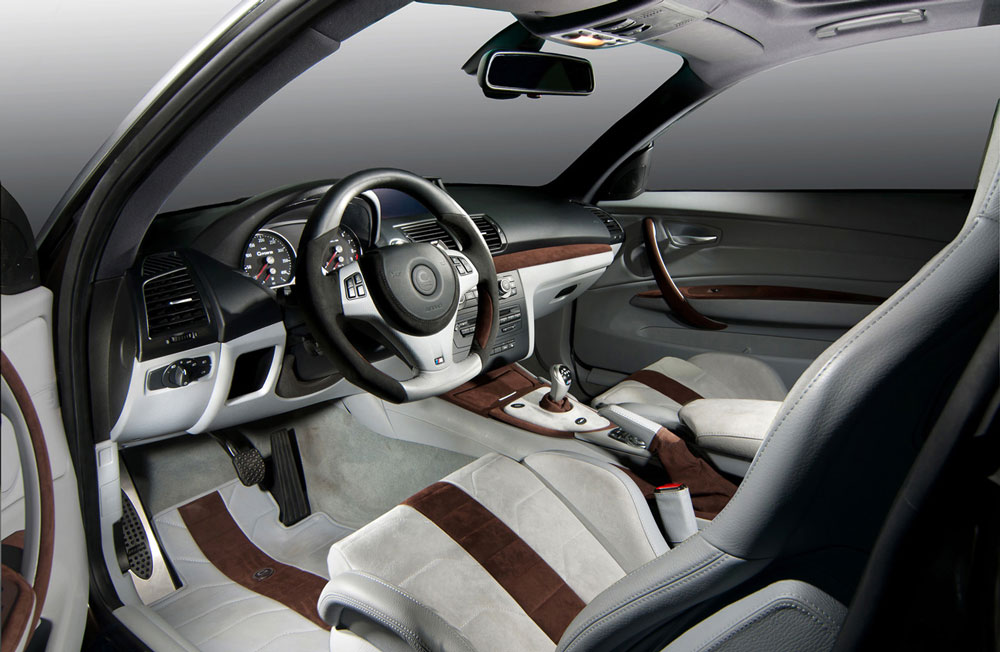
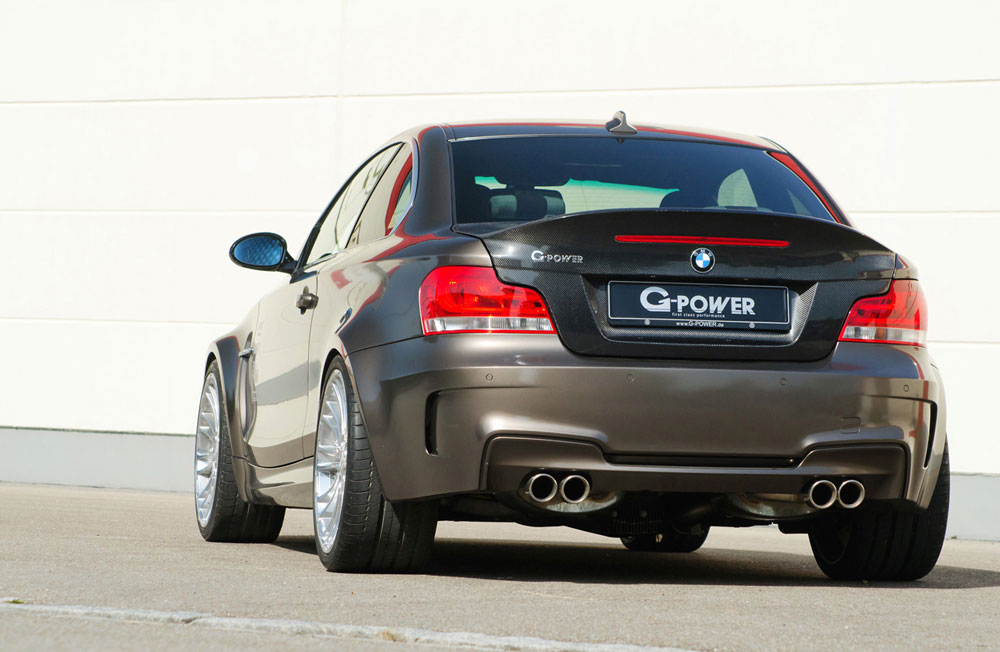
2013 G-Power BMW G1 V8 Hurricane RS

The 2013 G-Power BMW G1 V8 Hurricane RS is a modified version of the BMW 1 M Hurricane and the latest vehicle to be customized by G-Power.
G-Power is the leading supplier of supercharger systems for BMW engines, and has tailor-made the supercharger for the M3 engine. They have mounted the centrifugal supercharger from ASA, the T1-523, directly on the engine.

Specifications

General Info
Vehicle Type: Super Sport Coupe Est. Market Price: NA
Fuel Tank Capacity: 14 gallons (53L) MPG: NA
Dimensions
Length: 172.2 in. (437.3 cm) Wheelbase: 104.7 in. (265.9 cm)
Height: 55.9 in. (141.9 cm) Width: 71 in. (180.3 cm)
Curb Weight: 3362 lbs (1525 kg) Ground Clearance: NA
Luggage Capacity: 10.0 cu ft Maximum Seating: 2+2
Performance
Engine: Supercharged V8    Displacement: 4.0 Liter
Horsepower: 600 HP    Torque: 428 lb-ft
Transmission: 6-Speed Manual    Top Speed: 205 mph (329 km/h)
*Stock specs
Engine & Performance
G-Power has replaced the standard BMW M1 engine and gearbox with the engine and gearbox from the BMW M3 that are bigger than those in the M1 model. In addition, they modified the M3 engine, and the end result is a supercharged engine that generates up to 600 horsepower, 428 pounds-feet of torque and can achieve a top speed of more than 205 mph, making it the fastest car in its class. From a standing start, the car can reach 125 mph in just under 13 seconds.
Supercharger
The supercharger features an air box manufactured from cast aluminum. This houses a large air filter along with a water based cooling system that allows the supercharger to function at optimal temperature.
The net result of fitting the supercharger to the engine is an increase of 40% in torque. The system also results in the engine running efficiently, thereby reducing fuel consumption.

Braking & Suspension
Capable of astonishing speed, it is vital to ensure that the tires, suspension and braking performance of the BMW G1 V8 Hurricane RS are able to cope with all that power.
G-Power opted for Pilot Super Sport tires developed by Michelin, its technology partner, and sourced its braking system to Movit.
The company worked closely with KW to develop a suspension package it calls Clubsport, specifically designed for the G1 V8 Hurricane RS. The task was to come up with a package that allowed for comfort and stability in normal driving conditions while at the same time providing the stability, comfort and control required on a race track, and they have succeeded in doing this in the 2013 G-Power BMW G1 V8 Hurricane RS.

BMW 520d


The earlier-generation BMW 5-series was, by far, the largest selling car in its segment. A lot of this was down to the success of the earlier 520d. The carmaker has now introduced a cheaper diesel variant. The 520d, unlike the 525d or the 530d, is powered by a smaller 2.0-litre engine. But will this motor do justice to luxury car buyers? 
The engine is a turbo-charged, four-cylinder unit that displaces 1995cc, similar to the one in the 320d and old 520d. With 184bhp and 38.7kgm, performance is surprisingly good. It is responsive too, and helps make the car very driveable in urban traffic. Throttle response is almost instantaneous and you won’t be left wanting for more power in most situations. The Five cruises comfortably on the highway but this diesel’s forte is its petrol motor-like top end. Unlike most diesels, this one doesn’t mind being revved, which reveals its true BMW colours. Maximum torque comes from 1900-2750rpm and since this is where you reside most of the time, overtaking is a breeze, the eight-speed auto downshifting quickly when you floor the throttle. The well-matched, closely stacked gear ratios also help disguise this car’s displacement deficit. Of course, it’s no match for the 530d’s far more potent 3.0-litre engine, but it does the job nicely. 
The performance figures speak for themselves – 100kph comes up in a very brisk 9.09 seconds while the car will hit its top speed without breaking into a sweat. Thanks to the quick-shifting eight-speed gearbox, the in-gear times too are pretty impressive. 
If you are primarily chauffeur-driven and only occasionally take to the wheel, this engine will more than suffice. However, refinement and comfort, which are a priority in the rear seat, is where the 520d falls a little short. The engine is quite refined, but it can’t compare to the 530d’s silky-smooth six-cylinder motor. You will notice that it is more audible at idle and vibrates a tad more. It becomes a bit vocal too when worked hard.
There are few changes to the cabin – the beige colour and superb quality remain, making it a nice place to be in. Material quality and craftmanship are fantastic. The soft suspension setup remains, which means ride quality is very good and the car tackles rutted roads at low speed really well. But handling suffers and the car rolls and pitches a bit when you turn enthusiastic. Overall, the 520d feels in control  and you can rate its handling safe but boring. 
With sufficient power and a lower asking price, the 520d makes a strong case for itself.  At Rs 36.90 lakh (on-road, Mumbai) it costs just Rs 5.3 lakh more than a 320d Highline. So for some it may make sense to stretch their budget a little and go for the bigger, and in many ways, better car. With a smaller engine and lighter kerb weight compared to the 530d, fuel efficiency should be better. 
If performance is your priority, the 530d with 243bhp on tap will give you a bigger adrenaline rush and effortless performance. For all other purposes, the 520d will do nicely.

Fact File

Price Range (in lakhs)*
Ex-showroom price     Rs 36.90 lakh (Ex-showroom, Delhi)

Engine
Fuel                             Petrol
Installation Front, longitudinal, rear-wheel drive
Power 184bhp at 4000rpm
Torque 38.7kgm at 1900-2750rpm

Transmission
Gearbox                     8-speed auto

Dimensions
Length                       4899mm
Width 1860mm
Height 1464mm
Wheel base 2968mm
Boot volume 520-litres    

Chassis & Body
Weight                      1720kg
Tyres                      225/55 R17

BMW Z4 M Coupe

Feels like a modern muscle car; the ride might be a bit firm, but nothing puts a smile on your face like a BMW Z4 Coupe. It’s a modern legend.


    Comfort

    Possibly not. The ride is hard, there's not much headroom and you can't see anything that's further than 20ft from the rear windscreen because of the sloping roofline. But who gives a stuff? Sit down, shut up and hold on.
    Rated 10 out of 20


    Performance

    Two engines: 3.0-litre straight six with 265bhp, 0-62mph in 5.7 seconds and 155mph top end. That's fine and dandy until you drive the last-generation M3-engined Z4M Coupe with a 3.2-litre, 340bhp straight-six that'll get to 62mph in just five and head-butt the limiter at 155mph.
    Rated 10 out of 20

    Cool

    The Coupe is one of the coolest cars currently in production and don't let anyone tell you otherwise. As was the last one, actually, the now-deceased BMW Coupe.
    Rated 15 out of 20


    Quality

    Built like it should be; simple and strong. No issues here, though the silver plastic in the cabin can look a bit cheap in some lights.
    Rated 14 out of 20


    Handling

    Tail happy, hefty steering, no run-flats, no extra gubbins. The Z4 Coupe is pure joy for the driver. It's got huge grip, rides like a racing car and demands your attention all the time. Perfect.
    Rated 13 out of 20

    Practicality

    It's a hatch, but only small at 240 litres. It's got two seats, but don't apply if you're some sort of 6ft 4in super bean. You can't see out of the back and parking is a complete bugger. But you won't care after five minutes on a country lane.
    Rated 6 out of 20


    Running costs

    Group 18 or 20 for the pair of variants for insurance, 32-percent tax hit for the 3.0-litre, the full whack for the ‘M' car. Best compromise? The ‘M' car. No, really.
    Rated 10 out of 20

Now share it

BMW M6 overall verdict

The BMW M6 is a ludicrously fast coupe GT that can embarrass the odd supercar. Also comes in a way-too-flash drop-top version best left for Miami.


    Comfort

    Adjustable suspension makes light work of the bigger bumps - just stick it in ‘comfort' and go - but the M6 is a bit hard for most people. Other than that it's just like any other BMW 6-Series, so comfy and big enough in the front seats. Be aware that the seven-speed sequential manual's ‘auto' mode is pretty snatchy.
    Rated 15 out of 20
    Performance

    Unless you've got something Italian and with a six-digit price tag, be wary of the M6; it uses the M5's V10. That means 507bhp, a limited 155mph and 0-62mph in just 4.8 seconds. And this is a big car at 1650kg. The figures are pretty similar for the drop-top, although it's a smidge heavier.
    Rated 10 out of 20
    Cool

    The convertible, as we've said, looks great in Miami, less so in Mablethorpe. The coupe is cool for no other reason than that the engine and drivetrain are epic.
    Rated 8 out of 20
    Quality

    The 6-Series is hewn from one solid piece. Well, OK, not really, but lumps of granite will fall apart quicker.
    Rated 15 out of 20
    Handling

    The M6 is hard and flat in any situation, making the kind of scything turns you need from a big rear-wheel drive GT. It can generate huge amounts of lateral grip,but when it lets go and you've got the traction off, you'll dent more than just your ego.
    Rated 15 out of 20
    Practicality

    For a GT car the Six is fine for practicality. There's a 450-litre boot that loses 150 litres if you get the roofless one. But there's no ‘Touring' option.
    Rated 10 out of 20
    Running costs

    Group 20 insurance, low teens mpg -a Polo Bluemotion it ain't. Add to that a near £90k price tag and you have a very expensive toy, that manages to be £20k MORE than a BMW M5.
    Rated 10 out of 20

Now share it

BMW 7 Series overall verdict

An all-new Seven that actually doesn’t look like it. It’s a great car but some reservations about the ride and driving dynamics remain. Which is a weird thing to say about any BMW. Engines and gearboxes are superlative though.

    Comfort


    New suspension that can cycle between Comfort, Normal, Sport, and Sport Plus is a boon, but the big BMW never really settles in any of the modes. There's too much wind noise, too much bobble and far too much tweakery through the steering - the old car was better. Ooops. Still, we're talking about degrees of issues - it's lovely if you've come from, say, a 5-Series, but Merc S-Class owners won't be impressed.  
    Rated 12 out of 20

    Performance

    You can't argue with the way any of the variants goes in this generation - there isn't a duffer in this bunch. The best is the 730d - it hits 62mph in 7.2 seconds and 153mph with 41.5mpg economy. If you want the big hitter, then you need the 760Li; 6 litres of twin-turbo V12 power, 544bhp, 553lb ft of torque - it's fast and surprisingly fun - if you really need more than 0-62mph in 4.6 seconds and a limited 155mph top end, then you're a faster driver than us... 
    Rated 17 out of 20

    Cool 


    The gadgets on the Seven make it cool in itself, even if it is a bit sober-suited. Side-view cameras, infra-red head-up, speed-limit readers, four-wheel steer - it has it all. And there's something cool in it being quite quiet-looking - you just don't expect what it serves up.  
    Rated 12 out of 20

    Quality 


    The ride and wind noise issues might bother you if you're a sound-specialist, but otherwise the quality is top end. The cabin has a massive multimedia screen, the iDrive is now properly sorted - it's a very good thing. There's something about sitting in the driving seat of a big BMW that feels right.  
    Rated 13 out of 20

    Handling

    Four-wheel steer (a first on a BMW) gives stability at high speeds and a real smile when you try to park - it's got a great turning circle. It does the usual trick of shrinking when you go faster - but the steering is possibly a little too ‘connected'. For this class of car everything needs to be a bit more wafty - the German connection seems to have forgotten.
    Rated 15 out of 20

    Practicality


    The new Seven is biiiiiig. There's space for Playboy Bunnies galore, or hefty business guts. The boot is huge, and you get a massive range from a 730d. Even parking is easy - radar parking sensors and that turning circle work in the real world.  
    Rated 14 out of 20

    Running costs


    The BMW 730d is remarkably useful - you'll get 41.5mpg, 178g/km of C02. Ok, so it's a bit expensive and insurance is high, but it's worth it. If you want to simply ignore any credit crunchery, then go for that 760Li - 21.7mpg (which isn't that bad considering the performance) and group 20 insurance.  
    Rated 0 out of 20

Now share it

BMW 6 Series Convertible overall verdict


The Six is a much maligned big GT and the Convertible version isn’t half bad – especially as the M6. But it just lacks a certain something. That something is elegance.

    Comfort

    Perfectly comfortable at modest to fast speeds, a bit choppy at low speeds on rough surfaces. There’s not much wrong with the big BMW over long distances, and the engines are always a joy to get to know.
    Rated 12 out of 20
   
Performance

    Four-pot mills don’t exist in the 6-series, so you’ve got the choice of six, eight or ten cylinders. The 630i occupies the lower end of the range, the 635d and the 650i the middle, with the M6 V10 at the top. The 650i is perfectly quick for this sort of car: 0-62mph in 5.6 seconds, a limited 155mph and 367bhp. The M6 is a proper wig-worrier with over 500bhp, 0-62mph in 4.8 seconds and a similarly limited 155mph limiter. Perhaps the best compromise of the bunch (as usual) is the brilliant 635d; 0-62mph in 6.3 seconds (quick enough), the same 155mph limiter (quick enough) and just under 40mpg (good enough). The M6 will get low teens if driven enthusiastically. Ahem…
    Rated 17 out of 20
 
  Cool

    Less so than the Coupe. Don't argue, we all know that these things are written into the immutable laws of the universe.
    Rated 8 out of 20


  Quality

    Very solid creation from BMW, and the roof is lovely. BMW seems to get it’s interiors right (iDrive excepted), and the materials usage is second to none. The M6 Convertible is sober, but special. ‘M’ cars rule.
    Rated 13 out of 20
   
Handling

    The work done to the 6-series to make it worthy of the BMW badge is obvious – this isn’t some loosely butchered drop-top that wobbles. Saying that, it isn’t quite as good as the normal car, but most people won’t feel the difference because their flashy jewellery and/or bouffant hair will confuse the issue.
    Rated 15 out of 20
 
  Practicality

    The rear seats are best left to people who like a touch of S&M, because the loss of bloodflow to their lower legs can cause discomfort to some people. The boot also loses some space when the roof gets folded, so pack light if you want to go topless. Actually that makes quite a lot of sense. Otherwise there’s plenty of room up front and there’s no reason to fear the lack of a Coupe Convertible top when fabric lids are this good.
    Rated 12 out of 20
   
Running costs

    Insurance is at the higher end (18/19 and 20), sop not cheap. The 630i emits 188g/km and takes a 25-percent tax hit with 35.8mpg economy. The BMW M6 emits 366g/km, takes the max for tax at 35-percent and will get to the end of a decently long driveway before it runs out of fuel. Don’t expect more than low teens.

BMW X1 overall verdict


A small SUV based loosely on the 3-Series. But it's not an assault on the planet, thanks to BMW's efficient dynamics people who've kept C02 low and mpg high.

    Comfort

    Despite plenty of headroom, there's nowhere for lanky legs in the back. Fine for younger kids admittedly, but in a car with these proportions you'd expect to be able to get adults in there.
    Rated 14 out of 20
  
Performance

    There are three two-litre diesels - two single turbo'd engines making either 143bhp (18d) or 177bhp (20d) and a twin-turbo version (23d). The latter has 204bhp and 295lb ft of torque that's delivered with typically Teutonic gusto through a seamless six-speed auto. Weighing 1,670kg it may feel a little leaden at manoeuvring speeds, but once you're out and about it's genuinely brisk. And although in-gear acceleration is a far better measure of useful day-to-day performance, the standard stats are none too shabby either: 0-62mph in 7.3 seconds and a top speed of 127mph.
    Rated 14 out of 20
   
Cool

    It’s very hard to label the X1 as anything, except ‘odd’.
    Rated 9 out of 20


  Quality

    It's a BMW so you get quality materials throughout the interior, all feeling hardy yet pleasant to touch. Like all modern Beemers, the dash is a tad boring but entirely functional.
    Rated 14 out of 20
  
Handling

    Despite the increase in weight and height over a normal 1- or 3-Series, the expectation of dynamic competence that hangs over any BMW is essentially well met. The steering is a bit vague, but this favours cruising comfort over driving involvement and sensibly so. The X1 still feels superbly planted and relatively roll-free, but as ever the compromise is a ride that is too firm, transmitting more vibration through the cabin than you would expect from a car with such a high level of refinement.
    Rated 13 out of 20
   
Practicality

    The boot is huge, with 420 litres expanding to over three times that with the rear seats folded flat. And the raised ride height makes this all very easy to access. It's worth pointing out that the rear visibility is lousy.
    Rated 12 out of 20
    
Running costs

    No nasty surprises with a diesel-only range. All the engines return 45-50mpg, and thanks to low C02 emissions, company car tax bands are also good (the 18d and 20d are 21% and the 123d is 26%). The 18d and 20d also have a rear-wheel-drive version - sDrive - that raises economy to an impressive 54mpg.
    Rated 13 out of 20

BMW X5 overall verdict


It’s hard to argue with the new BMW X5 – it’s imposing to look at, amazing to drive and now has a seven-seat option. SUVs don’t come much better.

    Comfort

    The X5 is firm but well sorted, so it's really very comfy, especially over long distances. BMW has also installed some lovely seats which seem to suit the bigger driver and the car is quiet at all speeds.
    Rated 12 out of 20
   
Performance

    All the bigger BMW engines are wonderful and the X5 boasts the best. You can go for a ‘base'  3.0d (245bhp, 0-62mph in 7.3 and a 138mph top end), the same diesel tweaked to 306bhp (4.0d) or go for the range-topping twin-turbo 4.8-litre V8 with 408bhp, 155mph and 0-62 in 5.5.
    Rated 18 out of 20
 
  Cool

    It's a big SUV, so it's genetically incapable of coolness. Might want to respect it though.
    Rated 11 out of 20
   
Quality

    Build quality on the new X5 is exemplary. And the new gear selector is weird but brilliant.
    Rated 15 out of 20


   Handling
    Only the Porsche Cayenne comes close to the X5 in terms of on-road handling; the X5 can really shift. Swivel motors mounted on the anti-roll bars mean that at slow speed the X5 can ride well, and then when the going gets faster it can tighten itself up to feel more sporting. Feels a bit weird actually.
    Rated 14 out of 20

    Practicality

    For an extra grand you can have seven seats, which should stop bigger families drifting to the Land Rover Discovery, even though those rear seats are for kids really (even BMW makes that point). The car is huge, but visibility is good.
    Rated 13 out of 20
   
Running costs

    Petrol isn't the way to go if you're worried about running costs; the V8 gets low twenties. The diesel fares batter with 38.2mpg, but this is an expensive car to own and run - they start at Group 17 insurance.

BMW X6 Review


Looks, frankly, terrible. The ultimate two-fingers to all other road users that takes up road space while not making the best use of it; coupe body over X5-sized chassis. It does however, drive like precisely nothing else on the road.

    Comfort

    Surprisingly comfy over long distances, and every engine makes for relaxed cruising. The ride isn’t too hard even given the usual optional 20s running 335mm rubber, which is supercar wide. Space inside is also fine up front and for the two people in the rear, though headroom is marginally less accommodating than the BMW X5 thanks to the sloping rear end.
    Rated 11 out of 20
 
  Performance

    Four motors on offer, two diesels, two petrols. The two six-cylinder 3.0-litre diesels use one and two blowers respectively, giving 0-62mph in 7.5 (245bhp) and 6.5 (306bhp) seconds. The straight-six 35i petrol has 306bhp and gets to the benchmark in 6.7 seconds and runs on to just under 150mph. The twin-turbo 50i, with a bi-turbo 4.4-litre V8 and 407bhp will hit 62mph in 5.4, bang it’s head on an electronic limiter at 155mph and scare everything this side of a Porsche 911. There's even an M-Power version of this engine chucking out 555bhp. We wish we were kidding.
    Rated 17 out of 20
 
  Cool

    You will notice that no letters of the word 'cool' are contained within 'BMW X6'. This is no coincidence...
    Rated 4 out of 20
   
Quality

    As per the new X5, so a very solid performance from the BMW stable. Solid materials usage, good detailing, panel gaps that fit. This is a nicely finished car, even if it is built in America.
    Rated 13 out of 20
    
Handling

    Distorts what you expect from something with this high-looking C-of-G. The X6 covers ground, rough or otherwise with the same determination as a Bowler Nemesis, except with nice leather and a decent radio. Body control is superb, traction is always without peer thanks to xDrive, DPC (dynamic Performance Control) and DSC (Dynamic Stability Control). It will surprise you. You will still hate the way it looks.
    Rated 16 out of 20
   
Practicality

    Vision is limited thanks to that shape - the rear 'screen is a slot. There are only four seats and the boot is smaller than an X5's - but not by as much as you might imagine. The rear hatch lip is also very high - you’ll be struggling to get things out of the back if you’re short - though there is a very handy under-floor storage bin for hiding stuff.
    Rated 11 out of 20
    
Running costs

    Expensive. All hit the max tax bracket, and you’ll be fuelling that BMW 50i with everything you’ve got. Best just set fire to your wallet and have done. Best will be the single-turbo diesel, but this is still a big car with an appetite.
    Rated 1 out of 20

BMW 3 Series Coupe


BMW has raised the bar with the current generation of 3 Series Coupe. It's fast, frugal and fearless

Comfort

BMW's obsession with run-flat tyres has buggered the ride quality, and an inherently sporting set-up means that a BMW feels a bit stiff compared to non-German rivals. The 3-series is pretty good on space though, and all BMWs are usually quiet and accomplished cruisers.Rated 9 out of 20

Performance

The latest generation of 3 Series Coupe is available with nine engines. Coun 'em: 320i, 325i, 330i, 320d, 325d, 330d, 335d and the 420bhp V8 in the M3. The 325i is a lovely, smooth engine but it doesn't have the bite you'd expect for 218bhp. It's fast, yes, but it soon runs out of breath when pushed hard and it always leaves you wanting more. The 306bhp turbocharged three-litre 335i by comparison, is a real star. The peak torque arrives at 1,300rpm and stays on the same high plateau until 5,000. Okay, there is some turbo lag at the very lowest revs, but beyond 2,000 it picks up and runs like a V8. It's a cinch to make swift progress along A-roads, and because the urge is so accessible, passing slower cars is similarly simple. The M3's V8 is awesome, with terrifying levels of performance from it's four-litre V8.Rated 10 out of 20
 
Cool

All the big diesel cars are pretty cool. But a de-badged BMW 318i with ‘M-Sport' written all over it will make people want to hit you in the face with a hammer. And hammer wounds aren't cool.Rated 12 out of 20   


Quality

Built to BMW's typically high standards, the dash is basically as per the saloon, which means thick materials, tight panel gaps and all the buttons giving a lovely damped action.Rated 13 out of 20
 
Handling

It's a really fluent and obedient car and never does anything unexpected. In the dry you get heaps of grip, though the huge torque of the 335i makes it easy to spin the inside rear wheel coming out of bends. Even in the wet it keeps its superb balance. Pressing the DTC button calls up a slightly looser traction-control setting, letting you push harder before the electronics intervene to save you from you. The ride though, is very hard so expect to feel everything the road has to offer. Active Steering is available but we prefer the car without. Self centring in straight running is more natural when the fancy gadgetry is absent, as is the initial feel into corners.Rated 14 out of 20 

Practicality

Plenty of room in the back, despite the slightly lower roofline than the saloon. It's okay for adults in there, though no one would want to be climbing in and out too often unless they were in training for a pot-holing weekend. The boot is a good shape and at 440 litres a healthy size.
Rated 9 out of 20
 
Running costs

One of the most cost effective coupes to own. Even the 335i returns just under 35mpg and is three categories short of the maximum company car tax banding. The diesels are impressively clean and frugal while it's expected the car's residual values will be excellent.

BMW 1 Series

The BMW 1-series is a small premium Bee-Em that comes in every bodystyle; saloon, hatch, five-door and convertible. All are rear drive, but only the saloon looks any good.

Comfort

Not the most comfortable of cars because the ride can be jittery at times. Most versions are also stuck with doll's house rear seats and a Rubik's Cube-sized boot. Space in the front is fine though.
Rated 9 out of 20

Performance

Most people will be seduced by an exceptionally strong set of engines ranging from a 1.6-litre and 2.0-litre petrol, alongside four 2.0-litre turbo diesels. The 116d, 118d, 120d and 123d (all 2.0-litre) are the ones to have, but the 123d twin-turbo is the best; 204bhp, 0-62mph in just 7.0 seconds and 148mph is enough for most. Mid-50s mpg helps too.
Rated 13 out of 20
  
Cool

The saloon looks pretty darn good when optioned properly, and the convertible is clever and solid, but the 1-Series hatch always looks like you couldn't afford a decent BMW 3-Series. So not cool, actually.
Rated 9 out of 20

Quality

Solid BMW build makes this a premium thing to sit in and own. Nothing wrong here.
Rated 13 out of 20

Handling

Rear-drive makes the 1-Series one of the most satisfying small cars to thrash about in, but the lack of a limited-slip diff can be frustrating in the higher-powered cars if you really want to play. Great steering and a superbly controlled body are the key components.
Rated 13 out of 20

Practicality

The boot is tiny in the hatch at 330 litres, making it almost feel like it's from a class below. There's precious little room in the back too. Better to think of this as a small driver's car than the most practical of hatches.
Rated 7 out of 20

Running costs

Go for the diesels if you care about mpg and running costs - all get exceptional mileage and perform well. Do-able insurance (116i is group 10, the 118d group 11 - which also gets 63mpg and slips under the 119g/km limit) mean that the 1-Series is on a par with other hatches. Residuals are strong across the range - it's the BMW badge - which is why they are also expensive to buy. Rated 14 out of 20

BMW GinaLight Visionary


BMW Group Design has developed a two-seater roadster with the unique dynamic proportions that are typical of its brand. The BMW GINA Light Visionary Model takes the sculptural design that has already been established by a number of production cars to a new, unparalleled conclusion. The car’s front and sides, including the doors, create one single uninterrupted, seamless whole that converges to form an optical as well as a structural unit.

In order to create this appearance, it was necessary to move beyond all previous conceptions of car body configuration, design and materials. Therefore, the BMW GINA Light Visionary Model has dispensed with the usual body elements found on production vehicles such as front apron, bonnet, side panels, doors, wheel arches, roof, trunk lid and rear deck. Instead, a new structure with a minimum amount of components has taken their place. A special, highly durable and extremely expansion-resistant fabric material stretches across a metal structure. This new material offers designers a significantly higher level of freedom of design and functionality.

The body consists of only four elements. The largest component extends from the front of the vehicle to the edge of the windscreen and down the sides to the rear edge of the doors. The large side panels start at the front where the rocker panels emerge and run across the rear wheel arches into the rear. The fourth component is the central rear deck element.


An innovation breaks new ground: car with a flexible outer skin.

The innovation of a flexible outer skin breaks new ground in automotive engineering. This revolutionary solution opens up new design, production and functionality potential. It has a major impact on the interaction between driver and car and enhances it by offering a variety of entirely new options. Some elements of the substructure are moveable. The driver can move them by means of electro and electro-hydraulic controls. This will also change the shape of the outer skin, which can thus be adapted to suit the current situation, the driver’s requirements and can also enhance the car’s functional range.

The most striking example of this is the headlight design. In normal position, when the headlights are not active, i.e. when there is no necessity to illuminate the road, they are hidden under the special fabric cover. As soon as the driver turns on the lights, the contour of the front end changes. Activated by the metal structure that lies beneath it, the previously closed fabric cover opens to the right and left of the BMW kidney grille and reveals the BMW double head-lights. The rear and the rocker panels of the BMW GINA Light Visionary Model can also adapt both the shape and function to the driving situation in hand. Both can change the shape of their outer skin to meet the driver’s requirement for particularly dynamic motoring.


This concept also takes into account a potential interaction with aerodynamic requirements. The design of the rear element allows for automatic lifting of the rear spoiler when a certain speed is reached, thus creating extra downforce on the rear axle at higher speeds. Due to the fact that the entire rear end, including the spoiler, is covered by a single sheet of material that reaches as far as the rear compartment of the interior, the homogeneous shape of the car’s rear will not be affected by changes to the spoiler position. The mechanical system that moves the elements remains concealed.

The turn indicators and the taillights function without changes to the shape of the outer skin. Their position, however, is only revealed upon activation. The emitted light shines through the translucent fabric cover, which is permeable to light but not transparent.

The rocker panels demonstrate the formal versatility of the BMW GINA Light Visionary Model with an equally impressive performance. The air duct can be optimised if required. A corresponding movement of the metal structure results in an adjustment of the rocker panel contour to allow for better airflow. At the same time, an additional protruding rocker panel line emerges. The aerodynamic optimization and the length of the line can be infinitely adapted to the driving situation at hand.


Special fabric cover ensures accurate reproduction of material folds.
The fact that the body surface is designed by means of a flexible fabric cover that stretches across a metal substructure means that the materials used must meet exacting requirements. Industrially produced hybrid fabric made from a stabilizing mesh netting support and an outer layer that is both water-repellent and resistant to high and low temperatures is suitable for this application.

Another essential material property is a maximum level of dimensional stability. It must remain dimensionally stable irrespective of the temperature and air humidity it is exposed to even after severe and constant expansion. The dimensional stability helps retain the cover’s surface tension for a long period of time. The movement of individual body elements creates accurately reproducible folds in the material. In its choice of material BMW Group Design was inspired by exterior and interior architecture. The expertise of seat pattern designers working for BMW Group Interior Design was successfully applied in order to cut the fabric webbing to size with maximum precision, determine the strategic position of attachment points and stretch the material. As a result, the surfaces are remarkably well balanced and due to the steady tension that is retained between any two clearly defined points, the lines are extremely accurate.

The special fabric is supported by a metal wire structure. At specific points, the high-strength metal is enhanced by carbon struts with a higher flexibility. They are used predominantly for round, moving contours with a particularly narrow radius.


The use of large fabric areas and the possibility of changing the surface contours by moving individual parts of the metal mesh that lies beneath it create a new relationship between form and function. If additional cooling air is required, the BMW kidney grille at the front of the vehicle can be opened. Because the overall surface of the special fabric covering remains unchanged, the contraction at the front of the vehicle, which is necessary for functional reasons, has to be compensated for by extra tension in other areas. The result is an optically attractive interaction between various body parts that introduces a new dimension to sculptural design. The widening of the kidney grille openings is activated by a movement of the metal mesh in the front area of the side panels. This creates more tension, which becomes visible by the emergence of an additional character line. The development of this new contour tenses the front of the vehicle: the kidney grille opens up.

Innovative body structure introduces new functional dimensions.

The high-precision fit of the material to the metal mesh also allows surface changes without slackening the tension. In this case, opening of the surface by moving the respective steel mesh struts creates precisely defined folds in the material. TheBMW GINA Light Visionary Model uses this option to display a function that corresponds to the opening of the hood in conventional vehicles. The material opens at the centre of the engine cover and can be folded to the far right and left along an opening line that is approximately 0.5 meters long, to allow the driver or mechanic access to the service points in the engine.

The filler caps of the engine oil, cooling and wiper water tanks are now open for servicing. Opening and closing is similar to the mechanism on a doctor’s traditional medical bag, where clip-lock fasteners are held together in the middle by a rail.


The effect of the accurate surface material draping is even more impressive when the doors are opened. They swing both outwards and upwards. The high number of attachment points for the fabric cover positioned at the front of the car as well as at rear door edges creates a clearly defined and perfectly reproducible bulk of material. The draping is confined to the area between the front door edge and the side panel. Once the doors are closed, the folds in material disappear completely, leaving a perfectly smooth, stretched material surface.

The interior: discourse between driver and vehicle.

In the interior, variability, form and function are united in an inseparable connection. Whenever selected functions are accessed, the driver also changes the appearance of individual car elements. Again, the car’s variability is adapted to suit the driver’s needs. This creates a close interaction between driver and car in various different situations.

When the car is parked, the steering wheel and the round instruments – rev counter, speedometer and fuel gauge, which are vertically arranged on the centre console, are in idle position. This provides the driver with maximum comfort upon entering the car. Likewise, the seat only assumes its optimised functional position and shape if and when the driver sits down on it.


At that point, the headrest, previously firmly integrated into the seat’s backrest, rises up automatically. At the same time, the steering wheel moves towards the driver and the instrument panel moves in the same direction. The information on the best driver-specific position of both steering column and seat is stored in the transducer. The engine is started simply by pushing the start/stop button.

The smooth transition of interior and exterior that is typical of BMW convertibles is reinterpreted by the BMW GINA Light Visionary Model. The fabric that covers the rear deck runs into the interior and stretches across the driver and front passenger seats. The same material is also used for the surface design of the door trim and armrests. The shift lever in the centre console protrudes from tightly stretched textile bellows.

Driver and front seat passenger look out through a steeply inclined windscreen with the inside rear view mirror integrated into its frame. The side view mirrors are connected to the window frame. A narrow vertical dividing bar located at the center of the windscreen harks back to the typical windscreen division of traditional roadsters.

Innovative thinking put into practice: the BMW GINA Light Visionary Model.

With the BMW GINA Light Visionary Model, BMW Group Design focuses on a wide variety of issues that will determine the future conception of mobility.


It demonstrates the results of intense research into design, functionality, material and production. All ideas that have been put into practice in the BMW GINA Light Visionary Model are derived from the same motivation: to challenge conventional and previously pursued solutions. The quest for alternative options has generated a wide variety of different requirements that potential solutions are expected to meet. The main focus is on providing general versatility and catering to customer requirements with sophisticated solutions. In accordance with the GINA principle, every functionality enhancement helps to create an emotional bond between the driver and their car. The new solutions also allow for the option of fast, flexible and cost-efficient production.

Every innovation demonstrated by the BMW GINA Light Visionary Model also contributes to a clearly optimised resource management. As the quest for sustainability is one of the central issues of the GINA philosophy, new materials and manufacturing processes are expected to consume less resources and energy than previous solutions. Accordingly, the infrastructure used for manufacturing cars that are built in compliance with the GINA principle, has also changed. The manufacturing process requires fewer model-specific tools, and more highly-qualified skilled specialists. In all the areas referred to above, the BMW GINA Light Visionary Model has provided inspiration for more intense research into ideas conceived as a result of maximum creative freedom.

Emotional appeal of roadster models and visionary prospect of future cars.


The solutions conceived as part of this philosophy are not considered separately, but have been pooled in an integrating vision – a vision that is expressed in the context of an outstanding, fascinating car. The basic features of a roadster with its eight-cylinder combustion engine below a stretched front that applies motive power to the rear wheels in order to move the car along the road defines this context. The synthesis of elementary visions and sheer driving pleasure expressed by the appearance of the BMW GINA Light Visionary Model has a particularly striking emotional impact. Only the particular appearance of a fascinating car with its authentic design that creates a natural aesthetic look can bring to light the significance of the presented innovations.

The BMW GINA Light Visionary Model builds a bridge between vision and reality by presenting a number of features with a striking similarity with those found on production vehicles. The Roadster rests on 20? alloy wheels in a cross-spoke design with a matt silver finish. The car body is comprised of an exceptionally light aluminum space frame. Two double tailpipes for the rear exhaust system, a third brake light integrated into the height-adjustable rear spoiler, an air splitter at the front and a rear-end diffuser in a carbon design also meet the standards of a production vehicle.

Nevertheless, theBMW GINA Light Visionary Model retains its character as an object of research. It demonstrates the innovative force of BMW Group Design and its ability to challenge what is established, to find new solutions and to interpret these in the context of the car of the future at a high aesthetic level. This car is the logical continuation of the GINA principle in action. The GINA principle has already led to a variety of innovative concepts and has production vehicles in ways that are completely new and unprecedented by any other car manufacturer.

BMW Group Design uses concept cars such as the BMW concept car CS1 of 2002 as a step on the way towards putting a particular vision into practice. The CS1 was the first to present features such as the basic principle of the innovative control system – the BMW iDrive. Independently from all other innovative features shown by this concept car, the iDrive has become a series production feature.


Similarly, the GINA principle gave rise to an innovative manufacturing method that allows the manufacturers to decorate outer skin components that have been preformed by conventional methods with individually configured, high-precision contour lines prior to their reintegration into the manufacturing process. The Rapid Manufacturing method utilized for this process was first used during the production of hoods for the BMW Z4 M Roadster and the BMW Z4 M Coupé. In these models, the finished hood has received two distinctive contour lines prior to painting. These are not produced by a pressing tool but embossed into the metal with pin-point precision by a robot-guided steel pin.

Both examples illustrate the challenging route from a vision to a concept and to final series production that is not always straight and direct. With the GINA Light Visionary Model, BMW Group Design shows where this route begins. Not all innovations shown by the GINA Light Visionary Model will proceed to the next stages. In its entirety, however, the visionary look into the future shows the extent to which the BMW Group employs creative potential in its endeavour to respond to the challenges of tomorrow’s mobility.

BMW M3


BMW M3 GTS Interior

BMW M3 GTS‘s Interior equiped with thoroughbred racing bucket sets, carbon interior trims and an Alcantara® M steering wheel. The BMW M3 GTS‘s door and sidewall linings in the rear compartment are also made of Alcantara®. The BMW M3 GTS‘s body offers fastening points for six-point safety seat belts and an optional extension for the roll cage. The BMW M3 GTS is fitted with three-point automatic seatbelts for road use. Additionally the BMW M3 GTS supplied with six-point safety seat belts for driver and front seat passenger and a fire extinguisher complete the range of equipment.
BMW M3 GTS Specifications
Body

* Number of doors/seats 2 / 2
* Length/Width/Height (unladen) mm 4645 / 1804 / 1387
* Wheelbase mm  2760
* Track front/rear mm 1546 / 1539
* Turning cycle m  11.9
* Tank capacity appr ltr 63
* Cooling system incl. heating ltr 11-4
* Engine oil3) ltr 8.8
* Weight, unladen, to DIN/EU kg  1530 / 1605
* Max load to DIN  kg 350
* Max perm weight, overall kg 1880
* Max perm axle load front/rear kg 950 / 980
* Max perm trailer load (12 %)
* braked/unbraked  kg – / –
* Perm roof load/trail download kg – / –
* Luggage capacity l 430
* Air resistance  cd x A  0.34 x 2.17
Engine

* Config/no of cyls/valves V / 8 / 4
* Engine technology High-revving concept with individual throttle valves,
* Bi-Vanos, dynamically optimised oil supply and
* ionic-current knock control
* Capacity cc 4361
* Stroke/bore mm  82.0 / 92.0
* Compression ratio :1  12.0
* Fuel grade at least RON 95
* Max output kW/bhp  331 / 450
* at  min–1 8300
* Max torque Nm  440
* at min–1 3750
Electrical system

* Battery/installation Ah/– 70 / luggage comp
* Alternator A/W 180 / 2520
Driving dynamics and safety

* Suspension, front Aluminium double-joint spring-strut suspension with tension rod; small, positive steering scrub radius; traverse force compensation; anti-dive, coilover suspension with dampers independently variable in compression and rebound travel, variable wheel camber
* Suspension, rear Lightweight five-link rear suspension with anti-squat and anti-dive, rigid rear-axle support, coilover suspension with dampers independently variable in compression and rebound travel, variable wheel camber
* Brakes, front Six-piston fixed-calliper compound disc brakes
* Diameter mm 378 x 32, vented and perforated
* Brakes, rear Four-piston fixed-calliper compound disc brakes
* Diameter mm 380 x 28, vented and perforated

* Driving stability systems

* Fitted as standard: DSC incl. ABS and DTC (Dynamic Traction Control), CBC Cornering Brake Control, DBC Dynamic Brake Control, rain brake support,
* fading compensation, hill-start assistant, variable M differential lock, Electronic Damper Control

Safety features

* Fitted as standard: Airbags for driver and front seat passenger, side airbags for driver and front seat passenger, head airbags, three-point automatic belts with belt stoppers, pretensioners and belt-force limiters, crash sensors,
* tyre defect indicator, firmly bolted roll bar with fastening points for optional roll cage and additionally supplied six-point safety belts for driver and front seat passenger
* Steering Rack-and-pinion hydraulic steering
* with Servotronic function
* Overall steering transmission  :1  12.5
* Tyres front/rear 255/35 ZR19 /
* 285/30 ZR19
* Wheels front/rear 9J x 19 LM /
* 10J x 19 LM
Transmission

Type 7-speed M Dual Clutch Drivelogic transmission
Gear ratios  I  :1  4.780
II  :1  3.056
III  :1  2.153
IV  :1  1.678
V  :1  1.390
VI  :1  1.203
VII  :1  1.000
R  :1  4.454
Final drive  :1  3.154
Performance

* Power-to-weight ratio  kg/kW  4.6
* Output per litre kW/ltr  75.9
* Acceleration 0–100 km/h  s 4.4
*   0–1000 m  s  22.5
* Top speed km/h  305
* Fuel con in the EU cycle
* Urban  ltr/100km  18.4
* Extra-urban  ltr/100km  9.3
* Composite  ltr/100km  12.7
* CO2  g/km  295
* Emission classification   EU5